Pool Recording
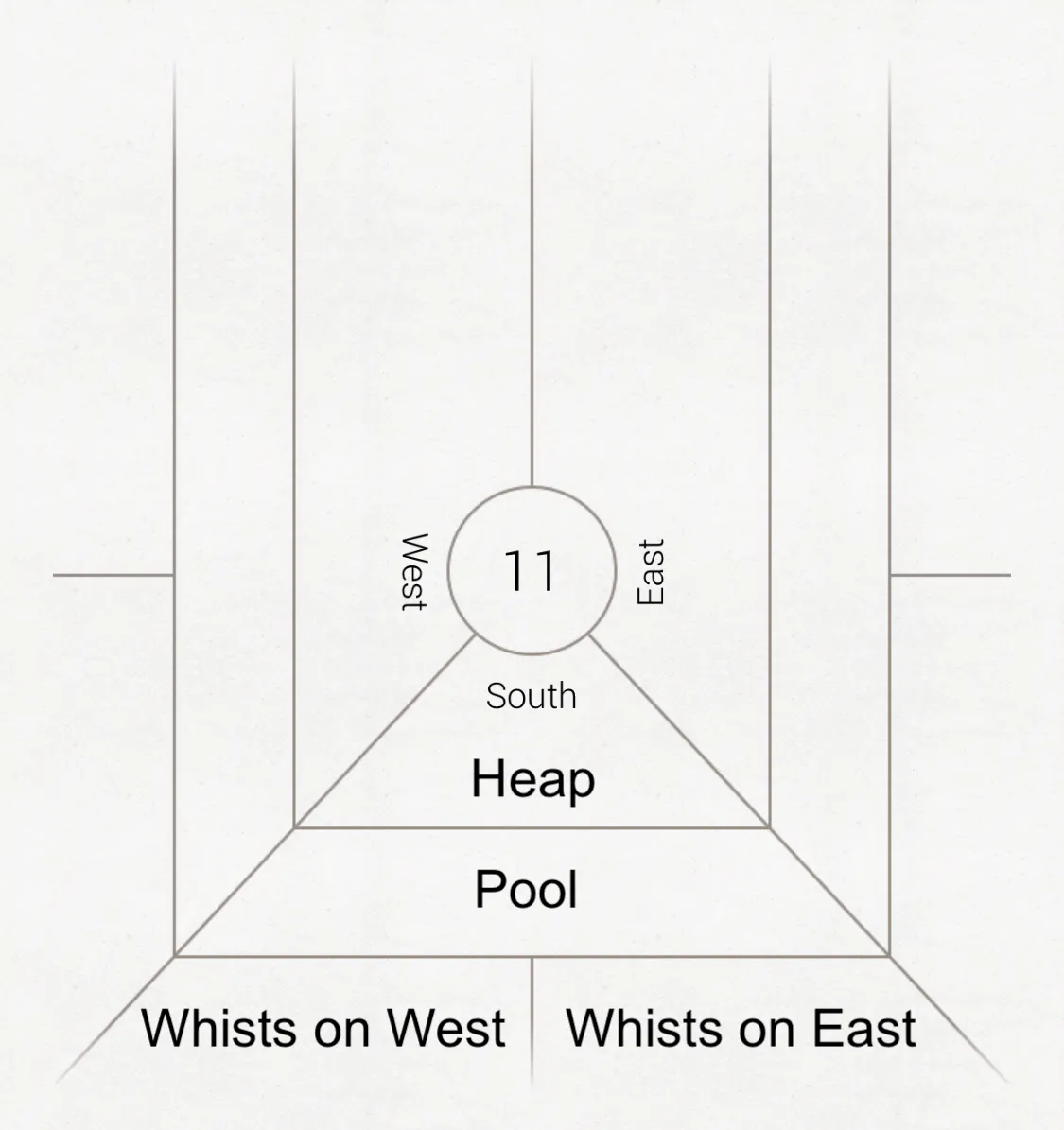
Preferans scores are kept on a special score sheet called the pool.
After every deal, the result is entered in the pool, heap, and whist fields. Write the new running total in each field, not the points earned in that deal alone. Add a dot after every number to separate one deal from the next.
Suppose you already have 2 in your pool. You make a seven contract and earn another 4. The next entry is 6., and the full line becomes 2.6. Do not write 2.4., because the last number would no longer show the current total.
The pool recording assistant at the end of this page lets you choose the convention and number of players, distribute all 10 tricks, and see exactly what to enter in every part of the pool sheet.
+2 to pool2.
+4 to pool2.6.
+6 to pool2.6.12.
What to write after a deal
The tables show the entry for a made contract, one defender trick, or one undertrick. Multiply the value by the number of tricks or undertricks where required. Rules such as gentleman's whist may change how points are divided between defenders. Switch between conventions to compare their values.
| Contract | Made contract, pool | Defender trick, whists | Declarer undertrick, heap | 1 missing defender trick, heap |
|---|---|---|---|---|
| 6 | 2 | 2 | 2 | 2 |
| 7 | 4 | 4 | 4 | 4 |
| 8 | 6 | 6 | 6 | 6 |
| 9 | 8 | 8 | 8 | 8 |
| 10 | 10 | 10 | 10 | 10 |
| Misère | 10 | no entry | 10 per trick | no entry |
| Contract | Made contract, pool | Defender trick, whists | Declarer undertrick, heap | 1 missing defender trick, heap |
|---|---|---|---|---|
| 6 | 2 | 4 | 4 | 1 |
| 7 | 4 | 8 | 8 | 2 |
| 8 | 6 | 12 | 12 | 3 |
| 9 | 8 | 16 | 16 | 8 |
| 10 | 10 | 20 | 20 | 5 |
| Misère | 10 | no entry | 20 per trick | no entry |
| Contract | Made contract, pool | Defender trick, whists | Declarer undertrick, heap | 1 missing defender trick, heap |
|---|---|---|---|---|
| 6 | 2 | 2 | 2 | 1 |
| 7 | 4 | 4 | 4 | 2 |
| 8 | 6 | 6 | 6 | 3 |
| 9 | 8 | 8 | 8 | 8 |
| 10 | 10 | 10 | 10 | 5 |
| Misère | 10 | no entry | 10 per trick | no entry |
The last column already accounts for the standard whist liability. Liability is full in Sochi and half in Leningrad and Rostov, except on a nine contract, where it is always full. With two whisting defenders, the penalty goes to the defender who failed to take their share of the mandatory tricks. You cannot simply multiply the defense's combined shortfall by the value in the table.
Fields on the pool sheet
The entire score sheet is called the pool. Each player's section contains a pool, a heap, and a separate whist field for every opponent. Whists always point to a specific player. An entry of "14 against West" in your section means that West owes you 14 whists.
If a field did not change after the deal, add nothing to it. Do not enter zero or repeat its previous total. Calculate the result of the deal, add it to the last number in the relevant field, and finish the new total with a dot.
Contract value
Ordinary entries start with the contract value. A made contract puts that value in the pool. When the declarer goes down, the same value is used to calculate heap and whist entries.
| Contract | 6 | 7 | 8 | 9 | 10 | Misère |
|---|---|---|---|---|---|---|
| Points to pool | 2 | 4 | 6 | 8 | 10 | 10 |
In Sochi and Rostov, each defender trick and declarer undertrick is worth the contract value shown in the table. Leningrad doubles the declarer's heap penalty and the whists, but the pool entry for a made contract stays the same. A defender's penalty for missing mandatory tricks is calculated separately.
The examples below use the standard Sochi, Leningrad, and Rostov settings. Players may agree on gentleman's whist, liability, all-pass progression, and other rules before the game.
The contract is made
The declarer writes the contract value in their pool: 2 for a six contract, 4 for a seven, and so on. If the pool already contains 6 and you make an eight contract, add 6 and write the new total: 12.
A whisting defender records whists against the declarer for the defense's tricks. With one whisting defender, that player records the tricks taken by both defenders. With two whisting defenders, each records only their own tricks.
For example, the declarer makes a six contract with 6 tricks. One defender whists and the other passes; together they take 4 tricks. Record the deal as follows:
| Field | Sochi | Leningrad | Rostov |
|---|---|---|---|
| Declarer's pool | +2 | +2 | +2 |
| Whisting defender's whists against declarer | 4 * 2 = 8 | 4 * 4 = 16 | 4 * 2 = 8 |
| Passing defender's entry | none | none | none |
If both defenders pass and one declares half-whist, that defender records half the mandatory whists. On a six contract this is 4 in Sochi and Rostov or 8 in Leningrad. Half-whist applies only when the table rules allow it.
The declarer goes down
First find the shortfall: subtract the declarer's tricks from the contract. Then make two separate entries.
- The declarer writes the contract value to the heap for each undertrick.
- Every opponent records an equal consolation against the declarer. Both the whisting and passing defenders receive it, as does the dealer in a four-player game.
Whists for tricks actually taken by the defense are added to the consolation. Under greedy whist in Sochi, the whisting defender records all of this part. Under gentleman's whist in Leningrad and Rostov, the two defenders divide it equally.
Consider the same deal in each convention. The declarer bids six and takes 5 tricks; the whisting defender takes 0 and the passing defender takes 5. The declarer is one trick short.
| Field | Sochi | Leningrad | Rostov |
|---|---|---|---|
| Declarer's heap | 1 * 2 = 2 | 1 * 4 = 4 | 1 * 2 = 2 |
| Whisting defender records against declarer | (5 * 2) + 2 = 12 | (5 * 4) / 2 + 4 = 14 | (5 * 2) / 2 + 2 = 7 |
| Passing defender records against declarer | 2 | (5 * 4) / 2 + 4 = 14 | (5 * 2) / 2 + 2 = 7 |
The defense misses its mandatory tricks
The defense must take 4 tricks against a six contract, 2 against a seven, and 1 against an eight or nine. If it falls short, the defender liable for the whist writes a penalty in their heap.
Suppose the declarer bids six and takes 7, while the only whisting defender takes the remaining 3. The contract is made, so the declarer writes 2 in the pool. The defender records 6 whists against the declarer in Sochi and Rostov or 12 in Leningrad, but also receives a heap penalty for one missing trick:
| Whisting defender's field | Sochi | Leningrad | Rostov |
|---|---|---|---|
| Whists against declarer | 3 * 2 = 6 | 3 * 4 = 12 | 3 * 2 = 6 |
| Heap | 2 | 1 | 1 |
Whist liability is full in Sochi, so the penalty is not reduced. It is half in Leningrad and Rostov. Liability is full on a nine contract in all three conventions.
Misère
A made misère gives the declarer 10 pool points. If the declarer takes any tricks, each trick adds 10 to the heap in Sochi and Rostov or 20 in Leningrad. Misère has no whist or consolation entries.
A badly played misère, or a perfectly caught one from the defenders' point of view, can turn into a "train": the declarer is forced to take several tricks in a row. Learn to play these positions confidently before bidding misère. The guide "How to catch a misère" explains the dangerous layouts and how to spot them.
| Misère, declarer takes 2 tricks | Sochi | Leningrad | Rostov |
|---|---|---|---|
| Declarer's heap | 2 * 10 = 20 | 2 * 20 = 40 | 2 * 10 = 20 |
Give up "without three"
If the table rules allow giving up "without three", the declarer may end the deal before play and write the value of three undertricks in the heap. Giving up a six contract costs 6 in Sochi and Rostov or 12 in Leningrad. Standard Rostov does not allow this option. No whists or consolation are recorded, and a misère cannot be given up "without three".
All-pass
In Sochi, every trick adds 1 point to the heap. In Leningrad, each trick adds 2 heap points, and the current all-pass progression multiplies the entire entry. Rostov has no heap entry for all-pass: the winner records 5 whists against each opponent for every trick that opponent took.
All-pass play is often overlooked, although it is one of the most important skills in preferans. The guide "How to play all-pass" covers the rules and main techniques.
For example, the same deal ends 3-3-4 on the first all-pass round. The two players with 3 tricks share the win.
| Entry | Sochi | Leningrad | Rostov |
|---|---|---|---|
| Player 1, 3 tricks | 3 to heap | 6 to heap | 10 whists against player 3 |
| Player 2, 3 tricks | 3 to heap | 6 to heap | 10 whists against player 3 |
| Player 3, 4 tricks | 4 to heap | 8 to heap | no entry |
In Rostov, each winner receives (4 tricks taken by the loser * 5) / 2 winners = 10 whists. A sole winner does not split the entry: with a 2-3-5 result, player 1 records 15 against player 2 and 25 against player 3.
Players sometimes agree on amnesty during all-pass. Before recording the deal, subtract the lowest result from every player's trick count. A 3-3-4 result becomes 0-0-1: only player 3 writes to the heap, 1 point in Sochi or 2 multiplied by the current progression in Leningrad.
Taking no tricks gives 1 pool point in Sochi and Rostov. In Leningrad, instead, 2 points multiplied by the current progression are removed from the heap. These entries are cumulative too: if the heap was 8, write 6. after removing two points.
A closed pool: help
In Sochi and Rostov, a player's pool closes when it reaches the game target. Any excess points first help close the largest opponent pool that remains open. The helping player records 10 whists against that opponent for every pool point transferred.
For example, the pool target is 11 and South already has 10. South makes a six contract and earns 2 pool points. One closes South's pool at 11. The other goes to the opponent with the largest current pool, or clockwise if none is larger, and South records 10 whists against that opponent. Leningrad has no help: South simply writes 12, and the game ends when the players' combined pool reaches the common target, which is the pool target multiplied by the number of players (for example, 11 * 3 = 33).
| After making a six contract at 10 of 11 | Sochi | Leningrad | Rostov |
|---|---|---|---|
| South's pool | 11 | 12 | 11 |
| Opponent's pool | +1 | unchanged | +1 |
| South records against opponent | 10 whists | nothing | 10 whists |
If nobody can receive help, the remaining points are removed from the declarer's heap. Players should agree before the game how to choose between opponents with equal pools.
How to record a deal
- Identify the result: a contract, misère, giving up "without three", or all-pass.
- Count the declarer's tricks and each defender's tricks.
- Use the selected convention to determine what goes into the pool, heap, and whist fields.
- For every field that changed, add the result to its last number.
- Write the new total followed by a dot. Leave unchanged fields alone.
Pool recording assistant
Choose a base convention, then change any table rules that affect recording. Use the person icon to select the declarer. In a four-player game, use the deck icon to select the dealer. The dealer takes 0 tricks in an ordinary contract, but may receive up to two talon tricks during all-pass. The calculator shows the new entries as if every field had been empty before the deal.
At the end of the game, the accumulated entries are converted into the final score. Amnesty, mutual whist settlement, and rounding are covered separately in "Pool calculation".